


Download King Sunny Ade Songs
31. Eni Binu Wa
Album – Classics Volume 2. Release Year – 2001.
32. Esubiribiri Ebomi
Album – Synchro System. Release Year – 1983.
34. Odun Titun
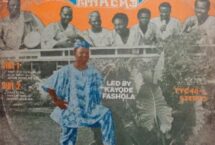
Album – Check E. Release Year – 1981.



Disclaimer! These songs are owned by the respective copyright owners and are used for review, research and promotional purposes only.
Biography: Who is King Sunny Ade?
King Sunny Ade is one of the most influential figures in Nigerian Juju music, a genre that blends traditional Yoruba sounds with modern instruments and influences. For decades, his music has brought together electric guitars, synthesisers, talking drums and layered percussion to create a sound loved by fans in Nigeria and beyond. Born into a family with royal connections, Sunny Ade left school to follow his passion for music.
His professional journey began in the mid-1960s when he performed with Moses Olaiya’s highlife band, the Federal Rhythm Dandies. In 1967, he formed his own group, initially known as the Green Spots. Dissatisfied with the way record companies treated musicians, he established his own record label in 1974. Over the years, the label released more than 100 of his recordings in Nigeria, giving him greater control over his music.
Sunny Ade began attracting wider attention outside Africa in the early 1980s when three of his albums — Juju Music, Synchro System and Aura — were released internationally through Mango Records, a subsidiary of Island Records. His band, King Sunny Ade and His African Beats, made its American debut in 1983, performing to enthusiastic audiences. With his distinctive sound and energetic performances, he was increasingly presented to Western audiences as a major figure in African music.
Although Juju Music and Synchro System received attention, Aura did not achieve the same commercial success, and his association with Island Records came to an end. His subsequent releases also had varying commercial fortunes. Authority of Your Ticket, released in 1990, attracted limited attention, while E Dide (Get Up), released in 1995, offered a fresh look at his music. In 1998, he released Odu, an album built around traditional Nigerian songs. It earned a Grammy Award nomination, further cementing his international reputation. He followed it with Seven Degrees North in 2000.
Beyond music, Sunny Ade has pursued several business ventures. The income from his successful recordings helped him establish interests in areas such as oil, mining, entertainment, film and video production, public relations and music recording. His business activities have also provided employment for many people.
He has equally shown an interest in supporting younger performers. In the mid-1990s, he established the King Sunny Ade Foundation, which was planned to include a performing arts centre, a modern recording studio and accommodation for young musicians and performers. The project was associated with a five-acre site donated by the Lagos State Government.
Sunny Ade has also played a role in Nigeria’s music industry beyond performing and recording. He has been involved in music rights and copyright advocacy, including serving as chairperson of the Musical Copyright Society of Nigeria.
In 1996, he formed a group known as the Way Forward, bringing together leading Nigerian musicians. His music has also featured in films and documentaries, including Juju Music (1988), Live at Montreux (1990) and Roots of Rhythm (1997).
Through his recordings, international performances, business interests and support for Nigerian music, King Sunny Ade has built a legacy that extends well beyond the stage. His work remains an important part of the story of Juju music and Nigeria’s wider musical history.
Disclaimer! All music files on this website are owned by the respective copyright owners and are used for review, research and promotional purposes only.