


Can a Flawless Mines Strategy Really Exist?
A flawless Mines strategy does not exist because every round includes unavoidable mathematical risk. Players can choose how much to bet, how many mines to include, which tiles to reveal, and when to cash out, but none of these decisions can guarantee a winning outcome. Betting systems may change the level of risk or the size of potential returns, yet they cannot remove the possibility of hitting a mine.
Claims about guaranteed patterns, perfect tile sequences, or loss-recovery systems usually confuse risk management with prediction. A cautious approach can reduce exposure by using smaller bets or cashing out earlier, while an aggressive approach can target larger multipliers. Neither changes the underlying probabilities. The most realistic strategy is therefore to manage risk rather than expect consistent guaranteed profits.
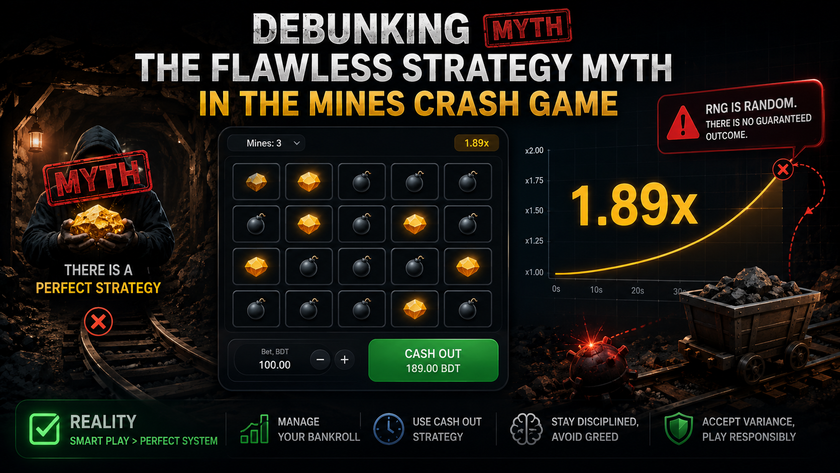
How the Mines Crash Game Works
Mines is played on a grid containing hidden safe tiles and a selected number of mines. Before a round begins, the player chooses a stake and usually decides how many mines will be placed on the board. A higher mine count increases the chance of losing but also raises the potential multiplier for revealing safe tiles.




After the round starts, the player selects individual tiles. Each safe selection increases the available payout multiplier, while uncovering a mine normally ends the round and loses the active stake. The player does not have to continue until every safe tile is revealed.
Instead, Mines includes a cash-out option that allows the player to stop after one or more successful selections and collect the displayed return. Continuing to reveal tiles can increase the possible payout, but every additional choice also carries the risk of ending the round without a payout.
Playing Mines Through the Mega Casino App
The Mega Casino app provides a convenient way to play Mines on mobile while keeping the game’s core mechanics easy to follow. The interface makes it simple to set a stake, choose the number of mines, reveal tiles, track the rising multiplier, and cash out before taking additional risk.
For Mines players, this mobile format is especially useful because every important decision remains visible during the round. Clear controls help players focus on bankroll limits and predetermined cash-out points instead of relying on supposed patterns or “guaranteed” strategies.
The app also suits short sessions, allowing players to manage stakes and stop playing without navigating through a complicated interface. However, the convenience of the Mega Casino app does not change the mathematics discussed throughout this guide. Mobile access can make Mines easier to manage, but probability, variance, and the house edge still determine the underlying risk of every round.
Why Every Mines Round Is Based on Probability
Every Mines round is governed by probability because the chance of selecting a safe tile depends on how many safe positions and mines remain on the grid. Suppose a 25-tile board contains three mines. At the start, 22 tiles are safe, giving the first selection a 22-in-25 chance of avoiding a mine.
If the first selected tile is safe, only 24 unrevealed positions remain, with 21 safe tiles and three mines. The probability therefore changes with every successful selection. As more safe tiles are removed, the proportion of dangerous positions gradually increases.
The number of mines also has a major effect. A board with one mine provides a much higher initial survival probability than a board containing ten mines. Larger potential multipliers compensate for this additional risk. No tile-picking pattern changes these mathematical relationships, which is why Mines outcomes cannot be reliably predicted through visual sequences or previous results.
The House Edge and Why It Matters
The house edge is the mathematical advantage built into the payout structure of a Mines game. Although the multiplier increases as a player successfully reveals more safe tiles, the offered payout is normally lower than a completely fair probability-based return would be. That difference creates a long-term advantage for the operator.
A betting strategy cannot remove this edge. Changing stake sizes, selecting different areas of the grid, increasing the number of mines, or following a fixed cash-out target may alter short-term volatility, but the underlying expected return remains governed by the game’s payout mathematics.
Why Previous Rounds Cannot Predict the Next Result
Previous Mines rounds do not provide a reliable way to predict where mines will appear next. In a properly implemented game, each new round is generated independently, so earlier mine positions, successful picks, and losing sequences do not determine the next board layout. Seeing a mine appear repeatedly in one corner does not make that position more or less likely to be safe in the following round.
Players often look for visual patterns after several rounds, especially when similar tile positions appear more than once. These patterns can occur naturally in random sequences and do not indicate that the game is following a predictable cycle.
The same principle applies to wins and losses. A run of successful rounds does not mean a loss is imminent, while several consecutive losses do not make a win more likely. Historical results may be useful for reviewing betting habits, but they cannot reveal the location of hidden mines in a future independent round.
The Gambler’s Fallacy in Mines Strategies
The gambler’s fallacy is the mistaken belief that previous outcomes make the opposite result more likely to occur next. In Mines, this can lead players to assume that a safe tile, a win, or a particular mine position is “due” after a long sequence of different outcomes. Independent rounds do not work this way.
For example, five losing rounds in succession do not improve the probability of winning the sixth round. The odds are determined by the current board configuration, including the number of mines and unrevealed tiles, rather than by the player’s recent results.
The same mistake can occur during winning streaks. Several profitable rounds do not automatically mean a loss must follow. Random outcomes can produce both long winning and losing sequences without changing the underlying probabilities. Betting more heavily because a reversal appears overdue increases financial exposure without creating a mathematical advantage. Each new round should therefore be assessed using its current odds, not previous streaks.
Do Certain Tile Positions Have Better Odds?
Certain tile positions are not inherently safer simply because they appear in a corner, along an edge, or near the centre of the Mines grid. When mines are distributed randomly and each unrevealed tile is treated equally, every available position has the same probability of containing a mine at the moment the board is generated.
Common strategies sometimes recommend selecting corners first, following diagonal lines, avoiding the centre, or repeating a pattern that previously produced a win. These methods can make gameplay feel more structured, but they do not improve the mathematical odds.
A pattern may appear successful across several rounds purely through normal random variation. Repeating it does not make the same tiles safer in future games. The probability changes only when relevant game variables change, such as the number of mines or the number of safe tiles already revealed. Choosing a preferred area of the board is therefore a playing preference rather than a statistical advantage.
Why Betting Systems Cannot Beat Mines Mathematics
Betting systems can change how stakes are distributed, but they cannot overcome Mines mathematics. Martingale increases the wager after losses, which can recover earlier losses only if a later win arrives before bankroll or table limits are reached. Progressive staking creates similar exposure by increasing bets according to a fixed pattern. Fixed betting is more controlled, but it does not improve the expected return.
Loss-recovery systems also fail to change the probability of selecting a safe tile. Each wager remains subject to the same game rules and house edge. These systems influence volatility and bankroll usage, not the underlying odds or long-term mathematical expectation.
What Risk Management Can Actually Do
Risk management cannot improve the odds in Mines, but it can limit how much money is exposed during a session. A bankroll limit sets the maximum amount available for play, while fixed stake sizes prevent individual bets from increasing sharply after losses.
Session limits can also stop extended play from turning short losing streaks into larger losses. Predetermined cash-out targets provide another form of control by defining when a player will stop revealing tiles and collect the current payout.
These methods reduce impulsive decisions and create clearer boundaries. They do not make safe tiles more likely or remove the house edge, but they can make bankroll use more structured and predictable.
How to Evaluate Mines Strategy Claims Critically
Mines strategy claims should be treated cautiously when they promise guaranteed profits, perfect accuracy, or a 100% success rate. No legitimate strategy can consistently predict randomly generated mine locations or remove the mathematical risk from each round.
Players should be especially sceptical of systems claiming to identify secret tile patterns, predict future boards, or use bots and software to guarantee safe selections. Screenshots of winning streaks and short-term results are not evidence of a reliable mathematical advantage.
Conclusion
There is no flawless strategy that can turn Mines into a guaranteed-profit game. The number of mines, remaining safe tiles, payout multipliers, and house edge determine the mathematical risk in each round, while previous outcomes and tile patterns do not predict what happens next.
Players can still make more controlled decisions by choosing lower-risk settings, using fixed stake sizes, setting bankroll and session limits, and deciding in advance when to cash out. These measures help manage exposure, but they do not improve the underlying odds.
The most useful approach is to treat Mines as a probability-based game rather than a system that can be solved. Strategies can influence volatility and playing style, but claims involving guaranteed wins, secret patterns, bots, or perfect prediction should be viewed critically.
Questions? Advert? Click here to email us.