

Pre-Colonial Political Administration of the Benin Kingdom
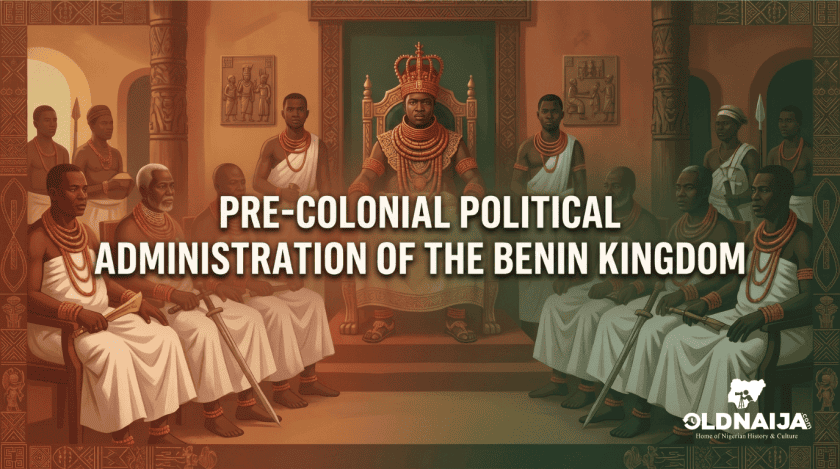
The Oba of Benin occupied the highest position in the kingdom, but governing Benin was never simply a matter of one man giving orders and everyone else obeying.
Hereditary chiefs, palace societies, town leaders, military commanders and craft guilds all had responsibilities within the political system. Their influence changed over time, and some could challenge the authority of the king.
The pre-colonial political administration of the Benin Kingdom, centred on Benin City in what is now southern Nigeria, developed around the Oba and a network of chiefs and institutions. The system helped the kingdom govern its capital, organise its economy, manage relations with other communities and maintain authority over territories beyond the city.

Understanding how this government worked requires looking beyond the Oba. The Uzama, the town chiefs and the three major palace societies were all part of the machinery of the Benin state.
How Was the Pre-Colonial Political Administration of the Benin Kingdom Organised?
The Benin Kingdom was a monarchy headed by an Oba, the king who served as the kingdom’s central political and sacred authority. The royal palace in Benin City was the seat of government, and important state affairs were handled through the Oba and the chiefs who served around him.
The Oba had extensive powers. He directed the affairs of the kingdom, appointed or recognised important title-holders, received tribute and presided over major political and religious ceremonies. His authority was also expressed through the palace, royal rituals and the kingdom’s relationship with its subordinate communities.
However, it is inaccurate to describe the Oba as an absolute ruler who was free from every established custom or political constraint.
Benin’s government included powerful chiefs whose titles, responsibilities and standing within the kingdom could limit royal decisions. The authority of the monarchy depended partly on maintaining relationships with these institutions.
The political system also changed during the kingdom’s long history. The position of the Oba and the influence of different groups were not identical under every ruler.
A description of Benin’s government in the fifteenth century, for example, should not automatically be applied to the eighteenth or nineteenth century.
Unlike a modern state with a written constitution and formally separated branches of government, Benin relied on established customs, royal authority, titled offices and palace institutions. These arrangements provided the framework through which the kingdom was governed.
What Was the Role of the Uzama in Benin Government?
The Uzama were a group of senior hereditary chiefs who held important positions in the Benin political system. They were among the oldest and most prestigious title-holders in the kingdom and had a recognised place in the selection and installation of a new Oba.
The group is commonly described as consisting of seven hereditary titles. These included the Oliha, Edohen, Ezomo, Ero, Eholo, Oloton and Edaiken. The exact historical descriptions of the group and the position of individual titles require care, since the institution developed over time.
The Oliha held a leading position among the Uzama and was associated with the installation of the Oba. The Ezomo was an important military title-holder, while the Edaiken was the title given to the heir apparent, or recognised successor to the throne, before his accession.
The Uzama’s authority was not limited to ceremonial duties. Their hereditary standing gave them political influence, and historical accounts describe periods when they opposed or restricted the power of the monarchy. Their relationship with the Oba changed as the institution of kingship became stronger.
Traditions about the early Benin monarchy describe the Uzama as having enjoyed considerable independence before royal reforms reduced some of their authority. These accounts should be read alongside written and archaeological evidence rather than treated as a complete record of events.
The Uzama therefore formed an important part of Benin’s political structure. They helped preserve established traditions of kingship and participated in the process through which a new ruler took office.
What Were the Three Palace Societies of Benin?
Some of the most important officials in the Benin Kingdom belonged to three palace societies: Iwebo, Iweguae and Ibiwe. Together, these groups were associated with the administration of the royal household and the daily organisation of palace affairs.
Iwebo was responsible for the Oba’s royal regalia, clothing and insignia. Its members were connected with the care of the objects and services required for royal ceremonies. The society also had links with palace craft guilds and administrative responsibilities that developed over time.
Iweguae served the Oba’s personal household. Its members included personal attendants and other palace servants who helped meet the king’s daily needs. The society’s responsibilities placed it close to the centre of royal life.
Ibiwe was responsible for the Oba’s wives and children. Its duties included the organisation of the royal household in which the king’s family lived. The society was therefore closely connected with the domestic and administrative arrangements of the palace.
These groups were more than household service organisations. Their members belonged to a structured system of palace offices, and senior title-holders could participate in wider affairs of government. Their responsibilities also connected the monarchy with the skilled workers who produced objects needed by the palace.
The three palace societies should not be confused with the Uzama. The Uzama were hereditary chiefs with a distinct position in the kingdom, while Iwebo, Iweguae and Ibiwe were organised around particular palace responsibilities.
Who Were the Town Chiefs and Other Important Officials?
The Oba did not administer Benin City and the wider kingdom without assistance from other titled chiefs. One important group was known as the Eghaevbo n’Ore, or town chiefs. Their responsibilities were connected with the affairs of the city and the wider political community.
The Iyase was the leading figure among the town chiefs and held one of the most influential titles in the kingdom. He could exercise considerable political and military authority and, according to historical accounts, was among the chiefs capable of openly challenging the Oba. The precise balance between the Iyase and the monarchy varied across different periods.
Another important title was the Ezomo, who had strong military associations and belonged to the hereditary Uzama. Benin’s military organisation was essential to the kingdom’s ability to defend its territory, conduct campaigns and maintain relations with neighbouring communities.
Other chiefs held responsibilities connected with palace administration, religious ceremonies, trade and the organisation of the kingdom. However, the original descriptions of officials called Unwagwe and Eribo as officers specifically responsible for supervising trade are not sufficiently established to present as settled facts. They have therefore not been included as a definite part of the administrative structure.
Benin’s government also depended on leaders outside the palace. Enogie, or hereditary chiefs, governed certain towns and communities under the authority of the Oba. At the village level, the Odionwere, usually an elder recognised as the community head, helped manage local affairs.
These local institutions connected the royal government with communities across the kingdom. Their authority and relationship with the Oba differed according to the history and political status of each settlement.
How Did Social Classes, Craft Guilds and Trade Support the Benin Government?
Benin society had distinctions of rank and status, but dividing the entire population into only two groups, nobles and commoners, gives an incomplete picture of how the kingdom worked.
The chiefs and titled officials occupied positions of privilege and political responsibility. Some titles were hereditary, while others could be acquired through service, achievement or royal appointment. A person’s standing depended on the title held, family connections, wealth and relationship with the palace.
Ordinary residents also contributed to the kingdom’s economic and political life. Farmers produced food, traders exchanged goods, and specialised workers made objects used in households, religious ceremonies and the royal court. These activities helped sustain Benin City and the authority of its rulers.
Craft production was particularly important. Benin was known for its brass and bronze casting, ivory carving, woodwork and other specialised arts. Skilled workers were organised into guilds, some of which were connected with the palace societies.
These guilds supplied objects for the Oba and the court, while their work also formed part of the kingdom’s wider economic and cultural life.
Trade connected Benin with communities across the region and, from the late fifteenth century, with European merchants, particularly the Portuguese. The exchange of goods brought new opportunities and resources, although the nature and scale of trade changed over the centuries.
It is also misleading to claim that every commoner owned an individual piece of land or that people generally worked on nobles’ farms in exchange for debt cancellation. Landholding and labour arrangements were shaped by kinship, community rights, status and local customs. They cannot be reduced to one arrangement that applied to every person in the kingdom.
How Did British Rule Change the Political Administration of Benin?
The political system of Benin experienced a major disruption in 1897, when British forces invaded and captured Benin. The expedition followed a period of growing tension between the kingdom and British imperial interests in the region. The Oba, Ovonramwen Nogbaisi, was eventually exiled to Calabar.
The invasion brought an end to Benin’s independence as a sovereign kingdom. The British removed the Oba from power, took objects from the royal palace and placed the territory under colonial administration.
Traditional institutions did not disappear completely. The monarchy was restored in 1914 under British colonial authority, but the Oba no longer exercised the independent political powers held by earlier rulers. The colonial government controlled the wider administration and determined the limits within which traditional authorities could operate.
The experience of Benin shows how colonial rule changed existing political institutions rather than simply replacing every traditional office. Some titles and customs survived, but their responsibilities and political influence were altered.
The pre-colonial political administration of Benin was built around the Oba, but it was sustained by many other institutions. Hereditary chiefs, palace societies, town leaders, craft guilds and local authorities all contributed to the running of the kingdom. Its history is a reminder that the power of a traditional ruler cannot always be understood by looking at the throne alone.
References:
- Bradbury, R. E. The Benin Kingdom and the Edo-Speaking Peoples of South-Western Nigeria. London: International African Institute, 1957. Print.
- Egharevba, Jacob U. A Short History of Benin. Ibadan: Ibadan University Press, 1968. Print.
- Igbafe, Philip A. Benin under British Administration: The Impact of Colonial Rule on an African Kingdom, 1897-1938. London: Longman, 1979. Print.
- Law, Robin. “The Historiography of the Kingdom of Benin.” History in Africa 18 (1991): 171-192. Print.
- The Bradbury and Igbafe book entries are supported by library catalogue records. Egharevba’s 1968 fourth edition was published in Ibadan by Ibadan University Press. Google Books+4
- Omipidan, Teslim. “The Benin Punitive Expedition of 1897.” OldNaija, 2 Nov. 2023, oldnaija.com/2017/03/17/benin-massacre-and-expedition-of-1897.
Questions? Advert? Click here to email us.