


Pre-colonial Political Administration in Yoruba Land
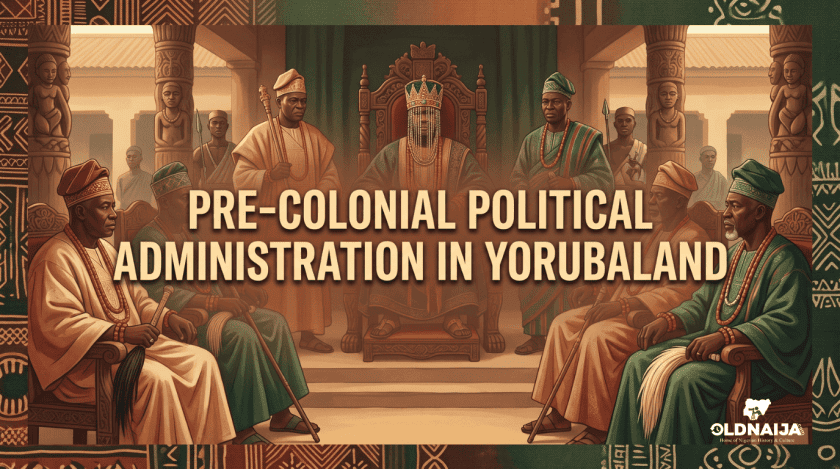
Before British colonial rule, Yoruba-speaking communities did not all answer to one king or follow one identical system of government. They were organised into different kingdoms and towns, each with its own political institutions and traditions.
Among them, the Old Oyo Empire developed one of the most extensive systems of administration in West Africa, with an Alaafin at its head and powerful councils and officials whose authority limited his freedom to rule as he pleased.
The pre-colonial political administration in Yorubaland varied from one kingdom to another. Oyo, Ife, Ijebu, Egba and other Yoruba states had their own arrangements for selecting rulers, settling disputes, managing subordinate towns and exercising political authority.
Although they shared some cultural and political ideas, it would be misleading to describe them as a single, uniform government.
The Old Oyo Empire provides a useful example of how political authority was organised. Its system combined kingship with councils of chiefs, military offices, provincial officials and other institutions that helped govern the capital and territories under Oyo’s influence.
How Was the Pre-Colonial Political Administration in Yoruba Land Organised?
There was no single political structure that governed every Yoruba community before colonial rule. In many kingdoms, the Oba (king) was the highest political authority, but he governed with the assistance of chiefs and councils representing important sections of the community.
In smaller towns and subordinate settlements, local rulers and chiefs handled community affairs. Depending on the kingdom, these leaders could be known by titles such as Baale, Oba or other local designations. They settled disputes, supervised communal activities and maintained relationships with the central authority where one existed.
The relationship between a central kingdom and its subordinate towns was not always the same. Some towns enjoyed considerable independence in their internal affairs but owed tribute or military support to a more powerful ruler. Others were more closely supervised by officials appointed by the central government.
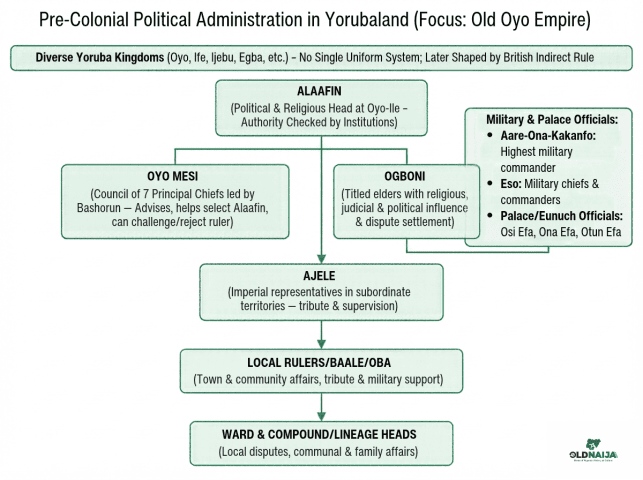
In the Old Oyo Empire, for instance, the Alaafin ruled from the capital, while officials known as Ajele were sent to some subordinate territories to represent imperial authority. This arrangement helped Oyo collect tribute and maintain political influence over areas beyond its immediate capital.
The structure also extended below the level of the town. Lineages, family compounds and wards had their own leaders, who dealt with matters affecting their members. This meant that political administration was not confined to the king and his palace. Authority operated at several levels of society.
The Alaafin and the Oyo Mesi: Who Controlled the Old Oyo Empire?
The Alaafin was the political and religious head of the Old Oyo Empire. He occupied the throne at Oyo-Ile, the imperial capital, and was responsible for the affairs of the kingdom. However, he did not exercise unlimited authority.
One of the most powerful institutions in the empire was the Oyo Mesi, a council of seven principal chiefs. Its leader was the Bashorun, who held an influential position in the government and played a leading part in the selection of a new Alaafin.
The Oyo Mesi advised the king on important matters of state and had considerable influence over political decisions. Its members could challenge the Alaafin when they believed he had abused his position or lost the support required to remain on the throne.
The council also played a central role in choosing a successor when the throne became vacant. A candidate came from the eligible members of the royal family, but royal birth alone did not guarantee succession. The selection process involved the kingmakers and other established customs of the kingdom.
Traditions about the removal of an Alaafin describe a formal rejection communicated through the presentation of an empty calabash or parrot’s eggs.
This was understood as a demand that the king should take his own life rather than continue ruling. The precise history and development of this practice are debated, so it should not be treated as a procedure that operated unchanged throughout Oyo’s history.
The political authority of the Alaafin was therefore balanced by the influence of the Oyo Mesi. This did not make Oyo a modern democracy, but it meant that the king had to contend with established institutions and powerful political interests.
What Were the Roles of the Ogboni, Aare-Ona-Kakanfo and Other Officials?
The Oyo Mesi was not the only institution involved in the administration of the empire. Other political, religious and military offices helped maintain order and protect the kingdom.
The Ogboni was an important association of titled elders with religious, judicial and political influence in several Yoruba societies. In Oyo, the institution formed part of the wider network of authority surrounding the Alaafin and the Oyo Mesi. Its influence was connected to traditional religion, social order and the settlement of disputes.
The Ogboni should not, however, be described simply as a parliament or a modern court. Its responsibilities and influence differed across Yoruba communities, and its relationship with other political institutions was shaped by local customs.
Military administration was another important part of Oyo government. The empire maintained a powerful army that helped defend its territory and extend its influence over neighbouring states. Its military organisation included the Eso, a body of military chiefs and commanders.
The Aare-Ona-Kakanfo was the highest-ranking military commander in the empire. The office was associated with leading Oyo’s forces in war and defending the kingdom’s interests. The holder was expected to demonstrate military ability and loyalty to the state.
Oyo’s military strength helped it exercise authority over several territories outside its capital. However, the empire’s military organisation also created political challenges. A powerful commander with an army behind him could become a threat to the central government, particularly when disagreements developed between military leaders and the Alaafin.
The Alaafin also relied on palace officials who assisted with the administration of the royal household and the affairs of government. Some historical accounts mention three senior eunuch officials known as the Osi Efa, Ona Efa and Otun Efa. Their reported responsibilities included political, judicial and religious matters, although details of their functions should be treated cautiously because accounts do not always agree.
How Were Provinces, Towns and Villages Governed?
The Old Oyo Empire covered a large territory, and the Alaafin could not personally administer every town and settlement. The government therefore depended on local rulers, provincial authorities and officials who represented the interests of the central government.
In some conquered or subordinate territories, the Alaafin appointed Ajele, who acted as imperial representatives. They helped supervise local rulers, collect tribute and ensure that the territory remained connected to Oyo’s political authority.
The Ajele were particularly important in territories where Oyo needed a direct presence to protect its interests. Their activities could include monitoring the conduct of local rulers and reporting developments to the capital. Their authority was not necessarily identical in every territory, since the relationship between Oyo and its subordinate communities varied.
Local rulers retained responsibilities within their own towns. They dealt with community affairs, maintained relationships with local chiefs and helped ensure that obligations owed to the empire were met. In some places, a Baale or another traditional ruler headed the local administration.
It is worth distinguishing between a Baale and an Ajele. A Baale was a local ruler or community head in certain Yoruba settings, while an Ajele was an official representing the Oyo imperial government in a subordinate territory. They did not automatically perform the same duties.

Below the town level, ward and compound heads also helped maintain order. Family heads handled disputes and responsibilities within their compounds, while ward leaders dealt with matters affecting several compounds. This arrangement allowed local issues to be addressed without every disagreement reaching the king’s palace.
Tribute was one of the obligations connecting subordinate territories to Oyo. The payment of tribute demonstrated political submission and helped sustain the imperial government. Some subordinate towns also supplied soldiers or other forms of support when required.
Was the Yoruba Pre-Colonial Political System Decentralised?
Many Yoruba political systems shared authority among rulers, chiefs, councils and local leaders. This gave them a measure of decentralisation, although the balance of power differed from one kingdom to another.
In Old Oyo, the Alaafin held considerable authority, but the Oyo Mesi and other institutions could restrict his decisions. Local rulers also exercised authority over their communities, while imperial officials supervised some territories on behalf of the central government.
This arrangement is sometimes compared with the modern principle of checks and balances. The comparison is useful when explaining how different institutions could limit the authority of a ruler, but it should not be taken too far.
Pre-colonial Oyo did not have a written constitution or the same separation of powers found in a modern federal state.
Other Yoruba kingdoms had different arrangements. In some communities, councils of chiefs played a major part in government, while in others, associations such as the Ogboni or Osugbo held important judicial and political responsibilities.
The Egba political system, for example, developed institutions that differed from the centralised imperial arrangement of Old Oyo.
It is therefore inaccurate to assume that every Yoruba kingdom followed the Oyo model. The political organisation of Ife, Ijebu, Egba and other communities reflected their own histories, traditions and relationships between rulers and their subjects.
How Did British Colonial Rule Change Yoruba Political Administration?
British colonial expansion brought major changes to political administration across Yorubaland. The process was gradual, and it did not affect every kingdom at the same time or in the same way.
The British established control through military campaigns, treaties, political intervention and the creation of colonial administrations. By the late nineteenth century, British authority had expanded across much of the region. The fall of the Old Oyo Empire earlier in the century had already weakened the older imperial political arrangement.
Under colonial rule, some traditional rulers retained their positions, but their authority increasingly operated within a system controlled by British officials. The colonial government used existing chiefs and rulers to administer local communities, a policy commonly known as Indirect Rule.
This did not mean that the old political institutions remained unchanged. Colonial authorities altered the powers of traditional rulers, influenced the selection and recognition of chiefs, and introduced new administrative boundaries and procedures.
In some areas, officials who had previously exercised authority through established customs found themselves answerable to colonial administrators.
The changes also affected the relationship between traditional institutions and local communities. Some rulers gained new administrative responsibilities, while others lost influence. The extent of these changes varied across Yorubaland.
The pre-colonial political administration in Yorubaland was not one uniform system waiting to be replaced by the British government. It consisted of several political traditions, each with its own institutions and history. Old Oyo remains one of the clearest examples of how kingship, councils, military authority and local leadership could work together, while also competing for power.
Thanks for reading, OldNaija.com
References:
- Johnson, Samuel. The History of the Yorubas: From the Earliest Times to the Beginning of the British Protectorate. Lagos: CMS Bookshops, 1921. Print.
- Law, Robin. “Making Sense of a Traditional Narrative: Political Disintegration in the Kingdom of Oyo.” Cahiers d’Études Africaines 22.87-88 (1982): 387-401. Print.
- Law, Robin. The Oyo Empire, c.1600-c.1836: A West African Imperialism in the Era of the Atlantic Slave Trade. Oxford: Clarendon Press, 1977. Print.
- Omipidan, Teslim. “Indirect Rule in Nigeria: Overview, Reasons and Effects.” OldNaija, 20 Dec. 2025, oldnaija.com/2019/04/30/indirect-rule-in-nigeria.
- Ogunnaike, Ayodeji. “Precolonial Yoruba States.” Oxford Research Encyclopedia of African History. Oxford University Press, 18 July 2022. Web. 24 November 2026.
Questions? Advert? Click here to email us.


great points altogether, you just received a brand new reader.
What may you recommend about your publish that you just made a few days ago?
Any sure?
Good day! Thhis post could not be written any better! Reading
throuth thks post reminds me oof my goood old room mate!
He always kept chatting about this. I will forward this article to him.
Pretty sure he will have a good read. Thanks for sharing!
You are greatly welcome.
So good and historical
Thank you for your visit and comment, Mr. Akin Adeyemo.
Nice post
Thank you, Ruthann.
this is really grate and amazing……nice write up
Thank you very much, Sir Islas. Your visit and nice words are highly appreciated. Please visit often.
9ice 1 from an intelligent person
Thank you for your nice words, Mr. Akinwunmi Abdullahi. Your visit is highly appreciated. Kindly do check back.
helpful and highly educative.
Thank you, Mr. Adams Fiona. Your visit is highly appreciated. Kindly do check back.
please can you post on the forebears who sold their subjects for rum and mirror,for gunpowder and tinsel toys
Yes I can. There is an article similar to that in my draft but I will make indepth research on what you have suggested and publish an article on it, very soon. Thank you for your visit, Miss/Mrs Jessica Chidinma. Your comment is highly appreciated. Kindly do check back.
I’m really much thrilled by ur articles. Very succinct though Historical. Bravo!! Great Job!
Thank you for your visit and nice words, Mr. Donatus Ozemhoya.
Amazing write up. Tons of help for my presentation in Nigeria’s people and culture class tomorrow. Thank you.
You are welcome, Derbiewanz. I’m really glad to know that. Thank you for your visit and comment. Kindly do check back.
As long as I’m concerned, for now, this is the only place I visited in the internet and it gave me exactly what I am looking for.
All the explanations are elaborate, clear and understandable. I love this, please keep it up.
Not accurate
We are glad you love this and we will surely keep it up. Thank you for your visit and encouraging words, Winnie. Kindly do check back.
It was awesome reading through this article……nice one i must say
Thank you, Osahon Igbinomwanhia. Your comment is highly appreciated. Kindly do check back.
every good one,it really help me
We’re glad to hear that. Thank you Mr. Timileyin.
wow,this is really impressive word for thought ,…am really pleased with i have seen here
wow,this is really great i wish i could know more about the policy of assimilation if u can enlight me more on it
Hmmm! what a concised historic content. in fact, this had answered my assignment question on the Yoruba political system of administration… your pen is mightier than the sword…thanks alot.
You are welcome, Mr. Bilyaminu Garba. Thank you for your visit and nice comment. Please visit regularly to get the best from OldNaija.
very useful article but you forgot to put your name in the article. written by who?
The article was written by me in the name of OldNaija.com
Thank you for your visit, Tokunbo. Kindly do check back.
thumb up for this
Thank you, Ayo. Kindly do visit again
Men you are great thanks for sharing this post????
You’re welcome sir. Kindly do check back
This is masterpiece, l don’t think l can find a better article on this topic. Great writing skills Biggie!
I appreciate ur write up.thanks alot.
Thanks for this,,,,,,,,,,,,really assisted me in my assignment
To be candid, It is well expatiated and elaborated write up, more ink to your pen.