


Political Administration of the Hausa-Fulani in Pre-Colonial Nigeria
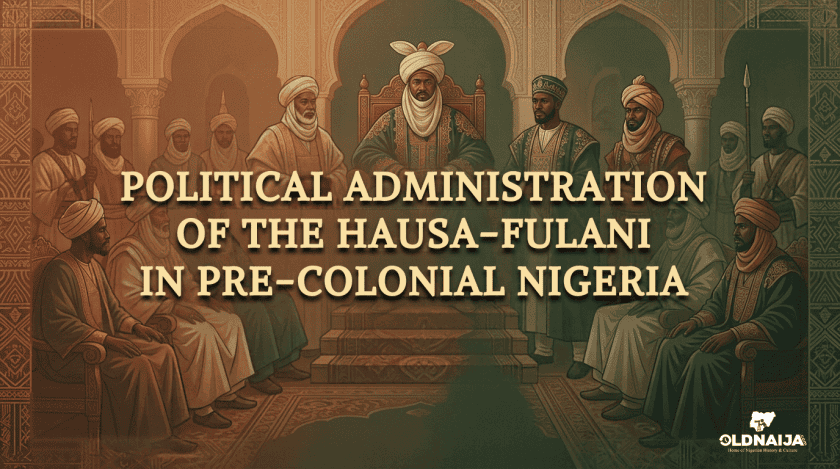
The political administration of the Hausa-Fulani was one of the most organised systems of government in nineteenth-century West Africa. From the caliph at Sokoto to the emirs who governed individual territories, authority was distributed through a network of officials responsible for taxation, security, justice and the daily administration of their communities.
This system emerged from the nineteenth-century Islamic reform movement led by Usman dan Fodio, which transformed the political organisation of Hausaland and neighbouring territories in what is now northern Nigeria.
Following the jihad that began in 1804, the Sokoto Caliphate developed an administrative structure that placed Islamic law and the authority of the caliph at the centre of government.
How Did the Sokoto Caliphate Establish Its Political Administration?
Before the nineteenth-century jihad, Hausaland consisted of several independent Hausa kingdoms and city-states, including Kano, Katsina, Zaria, Gobir, Daura and Rano. These states had their own rulers and established political institutions.
Although Islam had been present in parts of Hausaland for centuries, relations between Muslim scholars and some ruling authorities became increasingly strained over religious and political practices.
Usman dan Fodio, an Islamic scholar and religious reformer, emerged as the leader of a movement that challenged the existing authorities. The conflict that began in 1804 developed into a series of military campaigns that brought several territories under the control of the reformers and their allies.
The resulting political system became known as the Sokoto Caliphate. It was not simply a merger of fourteen Hausa kingdoms. Its territories included former Hausa states as well as other communities and regions brought under its authority through conquest, alliances and political arrangements.
The caliphate developed two major administrative centres: Sokoto in the northwest and Gwandu in the west. Usman dan Fodio initially provided overall religious and political leadership. However, he gradually delegated important responsibilities to members of his family and other trusted leaders.
His son, Muhammad Bello, became the leading authority at Sokoto, while his brother, Abdullahi dan Fodio, exercised authority from Gwandu. This division of responsibilities helped administer the expanding territories of the new state.
It did not mean that two entirely separate caliphates had been created. Sokoto and Gwandu functioned as the principal centres of authority within the wider Sokoto Caliphate.
How Was the Sokoto Caliphate Divided into Emirates?
The Sokoto Caliphate governed a large territory containing different peoples, towns and established political communities. Managing all these areas directly from Sokoto would have been difficult. The authorities therefore organised much of the territory into emirates, each governed by an Emir.
Important emirates included Kano, Katsina, Zaria, Gombe, Yola, Bauchi, Hadejia and Ilorin. The western territories included emirates and political centres such as Gwandu and Argungu. Their boundaries and political status changed at different periods as the caliphate expanded and its administration developed.
An Emir was appointed or recognised by the central authorities, although the process could involve established ruling families and local political interests. The caliph at Sokoto exercised authority over the eastern emirates, while the Emir of Gwandu supervised appointments and political affairs in the western territories on behalf of the caliph.
The emirs were responsible for governing their respective territories, maintaining security, collecting revenue and ensuring that Islamic principles were observed. They also owed allegiance to the central leadership and were expected to recognise its authority.
Although the caliphate had a central government, the emirates enjoyed considerable freedom in handling their everyday affairs. Local conditions, the strength of individual rulers and the distance from the political centres all influenced how much authority an Emir exercised.
What Were the Duties of Officials in the Hausa-Fulani Political Administration?
The Emir did not administer an entire emirate alone. He relied on senior officials who supervised different aspects of government. These positions formed part of an established system of political and military administration, although their titles and responsibilities could vary between emirates.
The Waziri was one of the most senior administrative officers. He served as a principal adviser to the ruler and supervised important government matters. At the central level in Sokoto, the Waziri also helped maintain communication between the caliph and the emirs.
The Galadima was another senior official whose responsibilities often involved territorial administration. Depending on the emirate, he could oversee the capital or supervise an important district.
The Madawaki held a military position and was associated with the command of cavalry forces and other military responsibilities. Military officers were particularly important because the caliphate had to defend its territories and maintain authority over newly acquired areas.
The Dogari was associated with security duties, including maintaining order and supervising palace guards or other protective personnel. The Ma’aji was responsible for financial matters and the management of public funds.
Other offices included the Sarkin Fada, who supervised palace affairs and the organisation of the royal household, and the Sarkin Ruwa, whose responsibilities were connected with water and river-related affairs. The Sarkin Pawa was associated with the butchers and the regulation of their trade.
These officials advised and assisted the Emir in governing the emirate. Their positions were not necessarily identical across all territories, and the importance attached to particular titles depended on local administrative traditions.
How Were Districts and Villages Governed?
Below the emirate level, the caliphate used a district administration to extend government authority into smaller settlements and rural communities.
Each emirate was divided into districts headed by officials known as Hakimai, the plural of Hakimi. A Hakimi was appointed by the Emir and was responsible for supervising the administration of his district.
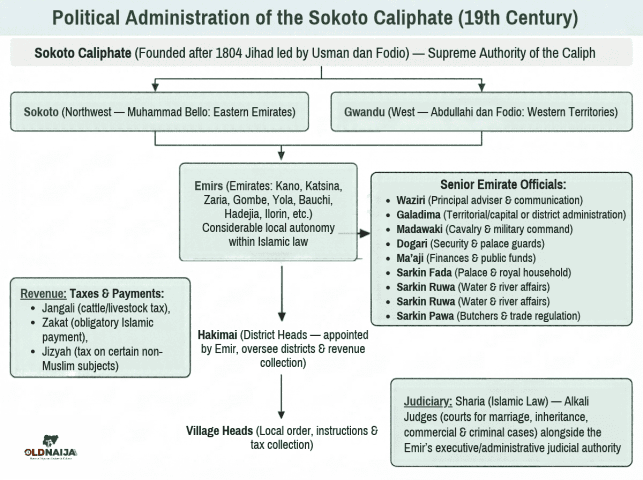
His duties included maintaining peace, resolving local administrative problems, supervising village heads and ensuring that government revenue was collected. He also served as an important link between the Emir’s government and the communities under his supervision.
Village heads assisted the Hakimai in carrying out these responsibilities. They helped maintain order, communicated government instructions and supported the collection of taxes and other revenues.
Taxation provided an important source of income for the caliphate. Among the taxes and religious payments collected were Jangali, Zakat and Jizyah.
Jangali was a cattle tax, particularly associated with pastoral communities and livestock ownership. Zakat was an obligatory payment prescribed by Islam, intended to support eligible groups and charitable purposes. Jizyah was a tax imposed on certain non-Muslim subjects under the Islamic legal arrangements of the period. It was not a land tax, as it is sometimes incorrectly described.
The collection and administration of these revenues helped support government activities, including the military, public administration and the maintenance of political authority.
How Did the Judicial System Work Under the Sokoto Caliphate?
Islamic law, commonly known as Sharia, formed the foundation of the judicial system in the Sokoto Caliphate. It influenced the administration of justice and covered matters such as marriage, divorce, inheritance, commercial disputes, debt and criminal offences.
Judicial responsibilities were largely handled by Alkali judges, who presided over courts and interpreted Islamic law. These judges were expected to possess the necessary knowledge of Islamic legal principles to examine cases and deliver judgments.
Larger emirates and important towns could have several Alkali courts to deal with the needs of their populations. The caliphate also maintained senior judicial authorities who supervised aspects of the legal system.
The Emir exercised considerable judicial authority within his territory, particularly in matters involving administration, public order and political disputes. Some cases could be brought before the ruler when they fell outside the ordinary jurisdiction of the Alkali courts or required the exercise of executive authority.
However, it would be misleading to suggest that the Emir could simply make any law he wished or that all judicial decisions depended entirely on his personal judgement. His authority operated within the religious and political framework of the caliphate, where Islamic law provided an important standard for government and justice.
Was the Hausa-Fulani Political Administration a Centralised System?
The political administration of the Sokoto Caliphate was centralised in the sense that the caliph held supreme authority over the wider state and its constituent emirates. Emirs were expected to recognise his leadership, maintain allegiance and comply with the broader religious and political principles of the caliphate.
Nevertheless, the system was not one in which every decision came directly from Sokoto. Individual emirs exercised substantial authority over their territories, while district heads and village leaders handled local administration. Senior officials also provided advice and performed specialised duties.
This combination of central authority and local administration made it possible to govern a large and diverse territory without requiring the caliph to supervise every community personally.
The system later influenced British colonial administration in Northern Nigeria. After the British conquest of the Sokoto Caliphate in the early twentieth century, Frederick Lugard’s Indirect Rule policy relied heavily on existing emirate institutions and traditional authorities to administer the region.
The British did not simply preserve the pre-colonial system unchanged. They reorganised political authority, placed colonial supervision over the emirs and altered the relationship between local rulers and their subjects. Even so, the established emirate structure made it easier for the colonial government to work through existing political institutions.
The administration of the Sokoto Caliphate demonstrates how religious authority, political leadership and local government were combined in nineteenth-century Hausaland. Its influence continued beyond the end of independent caliphal rule, particularly in the development of traditional institutions across Northern Nigeria.
References:
- Adeleye, R. A. Power and Diplomacy in Northern Nigeria, 1804-1906: The Sokoto Caliphate and Its Enemies. London: Longman, 1971. Print.
- Omipidan, Teslim. “Indirect Rule in Nigeria: Overview, Reasons and Effects.” OldNaija, 20 Dec. 2025, oldnaija.com/2019/04/30/indirect-rule-in-nigeria.
- Falola, Toyin, and Matthew M. Heaton. A History of Nigeria. Cambridge: Cambridge University Press, 2008. Print.
- Hiskett, Mervyn. The Sword of Truth: The Life and Times of the Shehu Usuman dan Fodio. New York: Oxford University Press, 1973. Print.
- Last, Murray. The Sokoto Caliphate. London: Longmans, 1967. Print.
Questions? Advert? Click here to email us.

There is no mention of the sarki who was the head of the hausa/fulani political system, why? or is the title EMIR the same thing as the SARKI?
Thank you very much, Mr. Roberta Dode. The Emir is also known as the Sarkin which means ‘head’ or ‘leader’. Your visit and comment is highly appreciated.
Hello. Could you point me to reliable books which discusses the pre-colonial legal systems in Nigeria> regards.
Nice work. Sir. Please how can I reference the work? Writing my BA project and I used this work. I need the reference. Thanks
Okay sir. Use this:
Pre-Colonial Political Administration In Hausaland; Teslim O. Omipidan; OldNaija.com; 2014
is cool
Thank you, Awele Ofili.
Very insightful piece. However, you did not discuss the several sources of revenue in the system
Thanks for your comment Mr. Chase Ogbuagu. We will include it very soon
pls am confuse on this question.the judiciary system of hausaland in the pre colonial.pls help.
Don’t be confused, Mr. Nwaigwe Prince. The judiciary system of Hausa was based on Sharia law which was interpreted by the Emir and the Alkali judges. The lesser matters were handled by the Alkali judges while important ones were handled by the Dmir. However, issues not covered by the Sharia law can be handled by the Emir. Thanks for your visit, Mr. Nwaigwe Prince.
Mr.Teslim Opemipo Omipidan thank you.
Excellent web site you have got here.. It’s hard to find quality writing like yours
these days. I really appreciate people like you!
Take care!! https://gamehotnews.com/2017/01/24/diy-wooden-beds-for-kids/
Thank you very much for your nice words, Mr. Fabian. An excellent website you’ve gotten too.
Thank you Sir,
Your work seems more detailed than most work I have come across.
Keep it up, we learn little, advance in it and tell more to generations to come..
You are welcome, Mr. Arimokwu Sunday. We will try all our possible effort to lift this platform to greater heights. Your visit and kind words are appreciated. Thank you.
alright, thanks for returning the appreciation. now that i know that you are 24 hours available, i will make sure through your help, we can be solving some academic issues together.
It will be my pleasure sir. Thank you.
i really value this…. thanks!
You’re welcome, Mr. Ken. We are glad you did. Thanks for your visit.
please I need help on this question :
explain some of the contraction that surrounded the origin of man in the Yoruba kingdom.
thanks …
please I need help on this question :
explain some of the contradiction that surrounded the origin of man in the Yoruba kingdom.
thanks …
Thanks for your question, Winner. There are many contradictions that surrounded the origin of the Yoruba people (or “man in the Yoruba kingdom”). There is a mythical account that stated the origin of the Yoruba people starting from when a supernatural being or a Yoruba god, Oduduwa created the earth and Obatala made human. It further stated that Oduduwa descended in Ile-Ife (the ancestral home of the Yoruba people) and begat seven children who founded the entire Yoruba race. https://oldnaija.wordpress.com/2015/07/15/mythical-creation-of-the-yoruba-tribe/
Also, there is also another account that claimed that the Yoruba people originated from Mecca. It mentioned a man named Lamurudu (Nimrod) and his priest Yar-harba (from which the name Yoruba was coined) as the progenitor of the Yoruba race. An account also pointed to Lamurudu as the father of Oduduwa.
Also, a renowned writer and monarch, Wajeed Obomeghie, declared that Oduduwa, the progenitor of the Yoruba race, was one Ekaladerhan, a Benin Prince, who had once escaped the community’s axe-man, but later re-appeared in Ife, after wandering in the bush from Benin for a longtime.
The creation account of the Yoruba people has appeared in different narrations all widely believed by Yoruba people (either in fractions or whole).
Thanks for your visit, Winner. You have a wonderful blog. Please visit often.
I really appreciate this your site, pls I want you help me find out the factors that lead to the establishment of the British empire. thanks
Thank you for your kind words, Mr. Ismail Aliyu. On what you requested for, we are sorry, we only provide information on Nigerian history or other related topics. But here are few links that might be of help.
* https://en.m.wikiversity.org/wiki/British_Empire/Tudor_Origins
* https://www.britannica.com/place/British-Empire
*http://www.britishempire.co.uk/timeline/timeline.htm
* http://www.historyworld.net/wrldhis/PlainTextHistories.asp?historyid=aa16
We hope these help. Thank you for your visit. We await your response.
I enjoy ur site
I’m glad you do. Thank you for your visit. Kindly do check back.
Wow…This is brilliant..Its so detailed..Thanks
You are welcome, Adeyipo Inumidun. Thank you for your visit. Kindly do check back.
I’m so greatful for this explanation….but pls why was the judicial administration of Hausaland based on sharia law?………….help me pls
Thank you for the question, Mr. Henry Chidera Victor. The judicial administration of Hausaland is based on sharia law because Islam is the predominant or mostly practised religion in Hausaland and the Sharia law is a subset of Islam religion. Sharia laws are Islamic rules and regulations which guides “the believers” (Muslims) in their day to day activities. I hope I have answered your question. Thank you for your visit.
Pls i need to understand pre-colonial administration and pre-colonial political system is there any relationship between them thanks.
Great one, am a new blogger, can I repost on my blog?
Pls, I want to brief consequences of the Fulani jihad {Danfodio jihad}.
please help me with this questions, the Hausa pre-colonia administrative system .
what are the main duties of the waziri in the hausa political administration?
What the meaning of Zakat
It means tax. Thanks for visiting, Mr. Joshua. Kindly do check back
Who appoint the emir on like the yoruba system were the BASHORUN appoint the king
you are indeed doing a great job in this your site
your answers are insightful and it goes directly to the point. you are good at what you do, keep the pace up bro.. thanks
You’re welcome, Mr. Abisedrick Jeremiah. Thank you for your visit and kind comment too. Please do visit again.
Wow, thanks.. So helpful
what about political-administration-of-the-igboland
Please what are the other taxes that were paid apart from he above 2 mentioned