


Aba Women’s Riots of 1929
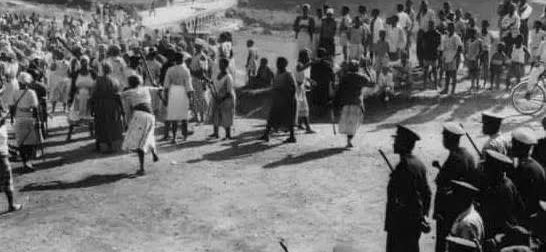
The series of protests and uprisings led by women in the Calabar and Owerri provinces of southeastern Nigeria in November and December 1929 came to be known in British colonial records as the Aba Women’s Riots of 1929, while in Igbo history and oral tradition, they are remembered as the Aba Women’s War.
During this period, thousands of Igbo women mobilised across towns and villages to resist the harsh and unpopular policies introduced by British colonial administrators. Their anger was sparked mainly by fears of new taxes on women, the abuse of power by warrant chiefs, and the disruption of traditional systems of governance.
Drawing on established forms of female political action such as collective protest, song, dance, and public shaming, the women challenged colonial authority in an organised and determined manner.


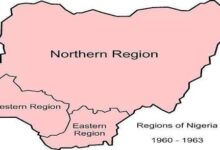
The scale and intensity of the uprising made it one of the most serious threats to British colonial rule in Nigeria. Court buildings were attacked, warrant chiefs were confronted, and colonial administration in large parts of southeastern Nigeria was effectively paralysed.

It took the colonial government nearly two months to suppress the movement, relying on armed forces that used deadly violence against unarmed women.
Causes of the Aba Women’s Riots of 1929
The roots of the Aba Women’s Riots can be traced back to January 1, 1914, when Nigeria was formally amalgamated and the first colonial governor, Lord Frederick Lugard, introduced the system of indirect rule in Southern Nigeria.
This system allowed the British to govern through local intermediaries rather than rule directly. While it functioned with some success in parts of Northern Nigeria, it proved deeply problematic in Igbo society, which traditionally did not recognise centralised authority or hereditary chiefs.
Warrant Chiefs
Under indirect rule, British colonial administrators appointed warrant chiefs (Igbo men selected and authorised by the colonial government) to oversee local administration. These chiefs were often imposed on communities without their consent and were not accountable to traditional institutions.
Within a few years, many warrant chiefs became increasingly authoritarian and abusive, using their positions to enrich themselves and assert unchecked power.
They seized land and property, imposed harsh and arbitrary local regulations, and jailed or fined anyone who openly challenged their authority. Although popular anger was largely directed at the warrant chiefs themselves, most people understood that their power ultimately came from British colonial administrators, making colonial rule the true source of resentment.
Taxation of Igbo Women
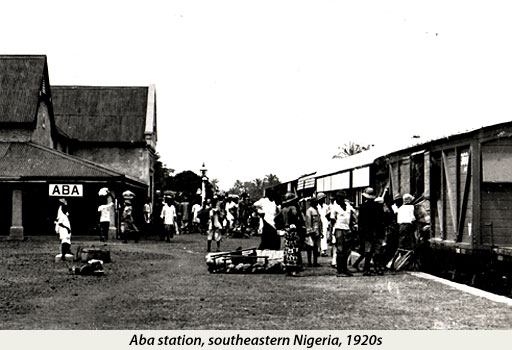
Tensions worsened when colonial officials announced plans to extend taxation to Igbo women, particularly market women. These women played a vital role in the local economy, as they were responsible for producing, transporting, and selling food and other essential goods to rapidly growing urban centres such as Calabar and Owerri.
The proposed taxes caused widespread fear and anger. Women believed that additional financial burdens would drive many traders out of business, reduce their ability to support their families, and disrupt the steady supply of food and non-perishable goods to the wider population.
Combined with the long-standing abuses of the warrant chief system, the threat of women’s taxation became the immediate spark that turned deep-seated grievances into open and collective resistance.
The Riot
In November 1929, thousands of Igbo women began to gather at Native Administration centres in Calabar, Owerri, and several smaller towns to protest against the abuses of the warrant chiefs and the proposed taxation of market women.
What started as localised demonstrations quickly spread across southeastern Nigeria, drawing in women from many communities and turning into a large, coordinated movement.
The women relied on traditional forms of protest, especially the practice known as “sitting on a man.” This involved all-night singing, dancing, drumming, and ridicule aimed at publicly shaming officials who had abused their authority.
Through these methods, the women expressed their collective anger and, in some cases, successfully forced warrant chiefs to resign from their positions.
As tensions escalated, the protests became more confrontational. The women attacked European-owned stores, including Barclays Bank, and broke into prisons to free inmates they believed had been unjustly detained. They also targeted Native Courts operated under colonial authority, destroying records and burning many of the court buildings to the ground as symbols of oppression.
Alarmed by the scale of the uprising, the colonial government deployed police and military troops to restore order.
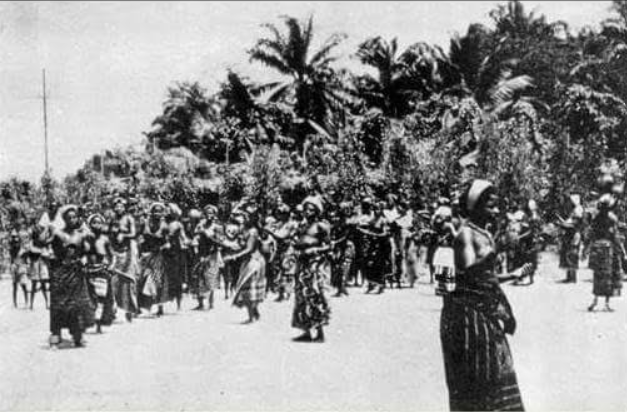
In Calabar and Owerri, these forces opened fire on unarmed crowds of women, killing more than 50 women and wounding over 50 others. You can view the list of people killed during the Aba Women’s riot here.
Over the course of the roughly two-month conflict, it is estimated that at least 25,000 Igbo women participated in protests against British officials and their local agents.
The uprising was later suppressed, but it achieved important results. The Aba Women’s Riots of 1929 compelled colonial authorities to abandon plans to tax market women and to limit the powers of the warrant chiefs.
The movement is widely regarded as the first major challenge to British authority in Nigeria and West Africa during the colonial period.
Thanks for reading, OldNaija.com
References:
- Judith Van Allen, “Aba Riots” or “Women’s War”?: British Ideology and Eastern Nigerian Women’s Political Activism (Waltham, MA.: African Studies Association, 1971);
- D. C. Dorward, ed., The Igbo “Women’s War” of 1929: Documents Relating to the Aba Riots in Eastern Nigeria (Wakefield, England: East Ardsley, 1983);
- Omipidan, Teslim O. (2014). Colonial Rule in Nigeria and Nigeria’s Struggle for Independence. OldNaija. https://oldnaija.com/2014/11/05/colonial-rule-in-nigeria-and-nigerias-struggle-for-independence/
- Nina Emma Mba, Nigerian Women Mobilized: Women’s Political Activity in Southern Nigeria, 1900-1965(Berkeley: University of California Press, 1982);
- Evans, M. (2009, March 27). Aba Women’s Riots (November-December 1929). Black Past
- Omipidan, T., & Omipidan, T. (2025, December 20). List of People Killed at the Aba Women’s Riot of 1929. OldNaija. https://oldnaija.com/2017/08/20/list-of-people-killed-at-the-aba-womens-riot-of-1929/
Questions? Advert? Click here to email us.




the Aba women riot was a genocide against African womanhood by the British govt. led by
Queen
A real genocide!
Thanks for your visit and comment, Mr. Fidelis McEkeh.
The Aba women riot was indeed a genocide. The colonial rule was deadly by imposing indirect rule and demanding taxes from poor market women was inhumane. May God help us!
Amen! Thank you for your comment, Shell Perekebena.
The levying of tax was not a genocide nor an attempt to commit genocide. It was simply an act of greed and a washing-away of tradition. Unhealthy acts to oppress the Igbo culture.
Even if the tax had been imposed, life would have gone on. Taxation, I think, is not Igbo-related yet the Igbo men continued living, did they not?
Yes
Yes, “the levying of tax was not a genocide nor an attempt to commit genocide”, but it was the main source of the genocide. If the British authorities had not imposed tax on Igbo market women, the women would not have protested and got killed as well. Also, the tax was imposed on market women who feared that if they pay the tax, there would be no gain left from their business. And they had to survive.
Thank you for your visit and comment, Mr. Ikemmuta Enyimba. Please visit often.
A Genocide is simply a deliberate act of eradicating an entire tribe. A commits genocide when A knowingly eradicates a tribe, nation or country. The British would have intended that their new law was passed and carried out without conflict. What ruler doesn’t want that? It was the fault of the women alone who were not coerced nor cajoled by anyone but themselves to rebuke such law. They knew that they were protesting against a powerful oppressor and with actions like that comes consequences. Did the British send them message? No.
Fine, the British didn’t send them, but if the women had stood arms akimbo and watched, Igbo market women, till today, will still be paying exorbitant tax. A market woman earned 10,000 monthly form her sales, she paid a tax of 7,000, her husband did the same, and they have a family to carter for, children to feed and rent to pay. The question is “will they survive”? Had it been that our educated elites and traditional rulers in the 1950s sat back and watched, what will be the fate of Nigeria today? We would probably still be strugling to gain independence and watching the British exploit our land. The women had no choice than to stand against the killer law of the British to save their coming generations. Or what do you think, Mr. Ikemmuta?
We are often guilty of exaggerating oppression. Taxation, at all is a foreign concept in Igbo society. And to have the women give in to that untraditional and delimiting concept is a taboo. A year ago, they manoeuvred it upon the men, and now they wished to impose it upon the women. No way!
This in anyway cannot be said better than this. Thank you for your visit and comment, Osita. Kindly do check back.
Always. Thank you for creating this blog. One of the things I’ve often thought completes a man, among other things, is his history, the complete knowledge of himself: why he is that way and all that.
Keep up the good work.
I’ll surely do, Osita. I really appreciate your nice, educating and encouraging words. I really do!
Thanks a lot
i never new some of these women were killed in the course of rioting.
Such humiliating move by the colonial masters
Humiliating indeed! You’re welcome and thank you also for your visit and comment, Osahon Igbinomwanhia. Kindly do check back.
I thrill when debating, I love activities that make me extend myself (exercises, brain games, learning new things, etc) and I thank you for providing this forum where diverse ideas thrive. Thank you.
However when you said, till today, I disagree with you. We’ve had four or three constitutions that have replaced the white man constitutions, so chances of any of his regulations remaining is nil.
Also, colonialism ended before the 21st century began, so chances of the British still being our master regardless of the educated elite fight, is nil.
Then, let us not as we Nigerians are accustomed to doing, exaggerate the facts. It was not a killer law. Even if the law had been imposed, they would still have survived. Are we not now suffering Buhari’s recession? Are we dead?
If that law stands that time maybe you wouldn’t have been opportune to go to school let alone to come write on this platform
Women at that time
fought for their rights
they were indeed brave…..women of today should learn from them
though the educated elites began to see reasons for the nations independence….and with time we gained our freedom…..now these same people are still the ones explioting the nations economy. Are they in anyway better than the colonialist then?..to me i think they are even worse because they take and dont give at all….somehow i feel if the colonialist still colonised us Nigeria would have been very much developed than this.
women are special, there is nothing a man can do better that a woman can`t do better
Yes, women are special! Thanks for your visit and comment.
Pls keep me updated