

The 1972 Indigenisation Decree: When Nigerians Took Back Their Economy
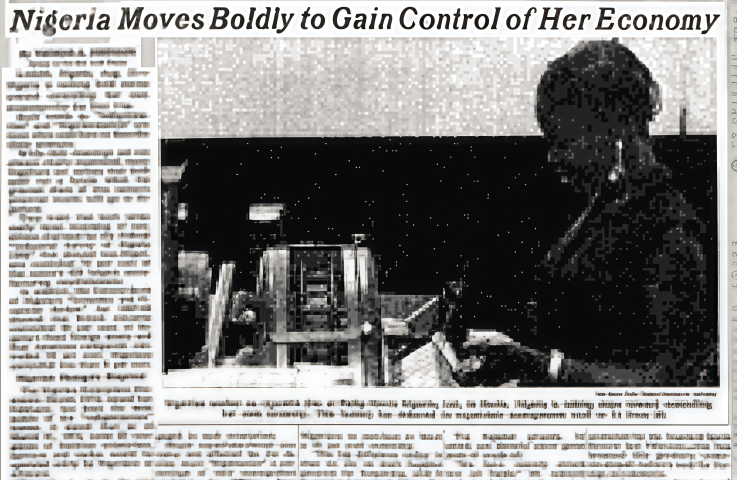
For over a decade after Nigeria gained independence in 1960, a strange reality persisted. While the country had its own leaders and its own laws, its economy was still largely a guest in its own home.
If you walked into a boardroom or a major factory in the late 1960s, you would find that roughly 70% of the largest firms were still controlled by foreign interests. Nigerians were the workforce, but we were rarely the owners.
On February 23, 1972, the Federal Military Government, led by General Yakubu Gowon, changed the course of Nigeria’s economic history by signing the Nigerian Enterprises Promotion Decree (NEPD), popularly known as the 1972 Indigenisation Decree. This wasn’t just a law; it was a bold attempt to hand the keys of the economy back to the people.

Why the Nigerian Enterprises Promotion Decree (NEPD)?
The Nigerian government realised that true sovereignty meant more than just having a flag; it meant controlling the “economic destiny” of the nation. The policy had three clear goals:
- Promote Local Ownership: The government wanted to ensure that Nigerians owned and managed the businesses operating on their soil.
- Empower the Educated Class: As more Nigerians graduated from universities, the decree sought to move them into high-level positions that were previously reserved for expatriates.
- Retain Wealth: By increasing local participation, the government hoped to keep profits within Nigeria rather than seeing them sent abroad.
How the 1972 Indigenisation Decree Worked
The transition was organised into three “Schedules” to ensure that the takeover was orderly and based on the complexity of the business:
- Schedule 1 (100% Nigerian): These were smaller, everyday enterprises. Things like bread baking, advertising, and small retail shops were reserved exclusively for Nigerians. No foreigner was allowed to compete in these sectors anymore.
- Schedule 2 (60% Nigerian): This group included medium-sized businesses like department stores and beer breweries. They were required to have majority Nigerian ownership.
- Schedule 3 (40% Nigerian): These were large-scale, high-technology industries like chemical manufacturing. Because these required specialised global expertise, foreigners could still hold a majority stake, but they had to sell at least 40% to Nigerians.
Companies Transformed by the Decree
Many of the household names we see today were forced to reinvent themselves during this era. They stopped being “foreign companies in Nigeria” and became “Nigerian companies.”
| Original Company | Transformation during Indigenization | Current Status |
| United Africa Company (UAC) | In the 1970s, it became UAC of Nigeria. Unilever initially acquired a 40% stake to comply with the decree. | Now a leading holding company managing brands like Mr. Bigg’s and Gala. |
| Standard Bank of Nigeria | Listed on the Nigerian Stock Exchange in 1971 to allow local ownership. It was renamed First Bank of Nigeria in 1979. | Remains Nigeria’s oldest and one of its largest financial institutions. |
| Lever Brothers (Unilever) | Became a publicly listed company in 1973, selling 60% of its shares to the Nigerian public. | Now Unilever Nigeria Plc; it remains a dominant force in home and personal care. |
| Guinness Nigeria | Forced to offer at least 40% of its shares to Nigerians during the 1970s. | Still a major player in the brewery sector; recently transitioned through further corporate acquisitions. |
The 1972 Indigenisation Decree had a great impact. It successfully created a new class of Nigerian multi-millionaires and business leaders. To help citizens buy these shares, the Nigerian government even established the Nigerian Bank for Commerce and Industry (NBCI).
However, the policy had its critics. Some argue it led to a drop in foreign investment because international firms were afraid of losing control. Others pointed out that some businesses struggled when the new owners lacked the technical experience to manage large factories.
Thanks for reading, OldNaija.com.
References:
- Onuoha, B. (1988, June 1). Indigenisation in Nigeria, 1972-1983 Resources and Income Re-Distribution. https://ir.unilag.edu.ng/items/918e90c0-993b-4c6a-963c-74b3df4f70d9
- Valentine., Nde Fru (2011). The international law on foreign investments and host economies in Sub-Saharan Africa: Cameroon, Nigeria, and Kenya. Berlin: Lit. p. 145. ISBN 9783643109743. OCLC 761742714
- Omipidan, T. (2025b, December 20). Colonial Rule in Nigeria and Nigeria’s Struggle for Independence – OldNaija. OldNaija. https://oldnaija.com/2014/11/05/colonial-rule-in-nigeria-and-nigerias-struggle-for-independence/
- Times, N. Y. (1972, September 2). Nigeria moves boldly to gain control of her economy. The New York Times. https://www.nytimes.com/1972/09/02/archives/nigeria-moves-boldly-to-gain-control-of-her-economy-nigeria-seeking.html
Questions? Advert? Click here to email us.