

The Berlin Conference And Partition of Africa
By the late 19th century, European powers were locked in an intense race to control African territory. What began as trade and missionary activity quickly turned into aggressive competition for land, resources, and political influence.
Order and restraint gave way to rivalry and suspicion, and tensions among European nations were reaching a breaking point. There was a real risk that conflicts in Africa could spill over into war in Europe.
It was in this tense atmosphere that Otto von Bismarck, the German Chancellor, stepped in. Concerned about maintaining peace in Europe while protecting Germany’s growing interests, he called for an international meeting in Berlin.


The goal was to settle disputes over Africa through diplomacy rather than war. This meeting became known as the Berlin conference.
Background to the Berlin Conference
Even before the Berlin conference, some European claims in Africa had already been made. A notable example was King Leopold II of Belgium, who had secured control over the Congo Basin through private treaties and exploration missions.
His claim was largely accepted by other European powers, setting a dangerous precedent for unilateral occupation.
However, as more nations rushed into Africa, overlapping claims became common. Britain, France, Germany, and Portugal were expanding rapidly, especially in West and Central Africa.
Without clear rules, confrontation seemed inevitable. This growing chaos made the Berlin conference appear necessary, at least from the European point of view.
The Opening of the Berlin Conference (1884–1885)
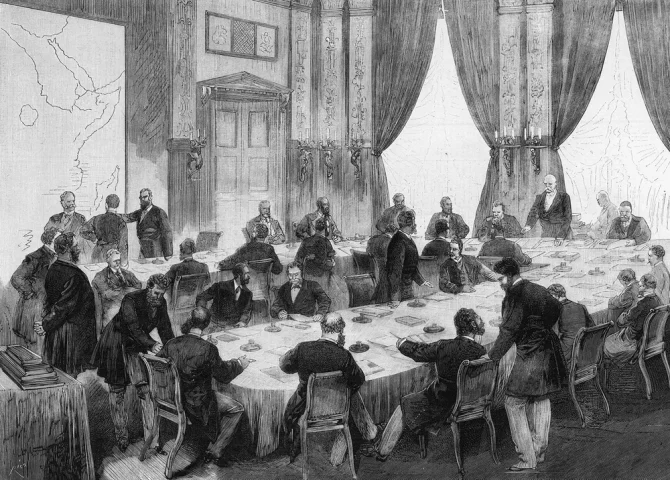
The Berlin conference officially began on 15 November 1884 and was held at Otto von Bismarck’s residence in Berlin.
Representatives from major European powers attended, along with the United States and the Ottoman Empire. African societies and leaders, whose lands were being discussed, were not invited.
The countries represented included Austria-Hungary, Belgium, Denmark, France, Germany, Great Britain, Italy, the Netherlands, Portugal, Russia, Spain, Sweden-Norway (then a unified kingdom), Turkey, and the United States. Their discussions focused mainly on Africa, particularly West and Central Africa.
One major agreement reached at the Berlin conference was that European powers would avoid armed conflict with one another when settling colonial disputes. Instead, they would rely on negotiation and mutual recognition of claims. This was meant to maintain peace in Europe, not to protect Africans.
Key Decisions and Agreements
Several important rules were established during the Berlin conference. One of the most significant was the principle of “effective occupation.”
Under this rule, a European power could only claim territory if it had actual control there, such as administration, military presence, or treaties with local rulers. This encouraged rapid expansion into the African interior.
The conference also declared that the Niger and Congo rivers should remain open to all European traders, regardless of which power controlled the surrounding territory. This decision was aimed at protecting European commercial interests, not African economic independence.
In Britain’s case, its claim over Nigeria was recognised after the treaties signed by the Royal Niger Company. The company’s leader, Sir George Taubman Goldie, played a key role in securing British interests and represented Britain’s position linked to agreements made with local rulers.
The Berlin Act and the Partition of Africa
The Berlin conference formally ended on 30 January 1885. Shortly after, on 26 February 1885, the Berlin Act was signed by the major European powers, including Britain, France, Germany, Italy, and Portugal. This act gave legal backing to the decisions made during the conference.
Following the Berlin Act, Africa was partitioned among European powers with little regard for history, geography, or culture. Ethnic groups were split across artificial borders, and rival communities were forced into single political units.
For example, the Yoruba people were divided, with some placed under British rule and others under French control in what later became Dahomey (now Benin Republic).
Distribution of African Territories
After the Berlin conference, Germany acquired territories such as Togo and Cameroon. Portugal retained Guinea and Cape Verde. Belgium, under King Leopold II, gained full control of the Congo Free State, later known as the Belgian Congo.
Britain secured some of the most economically productive regions, including Nigeria, the Gold Coast (Ghana), Sierra Leone, and the Gambia.
France acquired the largest number of colonies in West Africa, including Senegal, Guinea, Ivory Coast, and Dahomey, although many of these territories were less fertile or more difficult to exploit.
From Promises to Colonial Rule
The Berlin Act claimed that European powers would work to improve the social, economic, and political conditions of African societies. In practice, this promise was largely ignored.
After the Berlin conference, European nations returned to Africa and intensified their race for land, resources, and labour.
By the 1890s, further meetings, such as the Brussels Conference, attempted to regulate colonial activities. These efforts marked the transition from informal influence to full political control.
This process led directly to the establishment of colonial rule across West Africa and the rest of the continent.
Thanks for reading, OldNaija.com
References:
- Ajayi, J. F. A. (1969). Christian missions in Nigeria, 1841–1891: The making of a new élite. London, England: Longman.
- Omipidan, T., & Omipidan, T. (2025, December 20). Colonial Rule in Nigeria and Nigeria’s Struggle for Independence. OldNaija. https://oldnaija.com/2014/11/05/colonial-rule-in-nigeria-and-nigerias-struggle-for-independence/
- Crowder, M. (1968). West Africa under colonial rule. London, England: Hutchinson.
- Falola, T., & Heaton, M. M. (2008). A history of Nigeria. Cambridge, England: Cambridge University Press. https://doi.org/10.1017/CBO9780511819711
- Hargreaves, J. D. (1988). Decolonisation in Africa (2nd ed.). London, England: Longman.
- Pakenham, T. (1991). The scramble for Africa, 1876–1912. London, England: Weidenfeld & Nicolson.
- Rodney, W. (1972). How Europe underdeveloped Africa. London, England: Bogle-L’Ouverture Publications.
Questions? Advert? Click here to email us.